JOHN CARTER:
TAYLOR KITSCH QUESTION-AND-ANSWER
Plus BIOGRAPHY
www.cartermovie.com/news/taylor.html
Following is a Disney studio-provided
question-and-answer interview - January 1, 2012
with Taylor Kitsch, who stars
in the lead role in John Carter.
Photo Galleries:
CONTENTS
Page
I | Page
II | Page III
| Page IV |
Page
V | Page VI
| Page VII |
Page
VIII |
Page
IX |
Page X
|
Page XI |
Page
XII |
Page XIII
|
Page XIV
Your
character John Carter has an amazing back-story. How did that inform you
as an actor?
When I first read the script, I
was drawn to the character-driven story and the fact that it will benefit
from being a big studio movie. It gave the filmmakers a chance to make
the film in an amazing way. You get to know John Carter's background with
his family, the Civil War and everything. It's heavy to play but it gives
me such a base to draw from through the whole movie. For example, in one
scene, you'll see Carter playing with his rings and you'll know what that
truly means to him. It's great as an actor because it's something to really
dive into. It's great.
What kind of character is John Carter?
Carter is a man who has lost everything
he ever cared about. He comes back from the Civil War to find his wife
and child dead. He basically goes into this recluse mode of living and
is driven to mine for gold. It's like a Band-Aid solution -- he's covering
up what he hasn't dealt with, the guilt and the loss of his family, whom
he went to war to protect.
He has a fear of taking responsibility
again and that's what he's fighting through the whole movie. He lands in
the Civil War between Helium and Zodanga. He's on Mars but their conflict
is incredibly relatable for him, so he just wants nothing to do with it.
You have Dejah, Tars and everyone reminding him or literally telling him
that there's a cause here and you have to be part of it whether you like
it or not. He's made that choice before and everything was just ripped
from him, so obviously there's that fear of actually engaging in that again.
So that's what he's always pushing away from.
This movie covers such an incredible
epic span from the Civil War era to Western America to Mars. How was the
epic adventure sense of it for you as an actor?
The grandeur and what Stanton's
done and how it works and how it's all intertwined is quite epic and I
felt that as an actor. My character is definitely on an epic adventure.
We go from the 1800s on the streets of New York to the Arizona Territory
in the West, to the plains of Mars -- all in one movie. As an actor I experienced
my character John Carter in many different settings that had specific emotions
and needs that I had to evoke.
I can't recall any movie that's
done it the way we have. The ending brings the adventure full circle brilliantly,
but you'll have to see it to understand what I mean.
What do you think audiences are going
to love about this movie?
There's a lot. I keep saying that
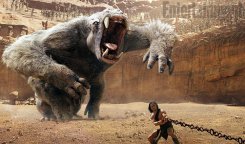
the great white ape scene is worth the price of admission alone. Visually
it's going to be incredible. I think they'll like the characters; they're
going to be able to relate. It's not just a special effects movie with
things blowing up and basically one guy that you don't care about. You
care about John Carter and you care about his journey. You see an incredible
arc of who he is, his new beginning and rebirth, and although you have
special effects, you've also got the brilliant actors whom I've had the
fortune of working opposite as well.
Please talk about your character's relationship
with Lynn Collins' character, Dejah Thoris.
In the books it's almost love at
first sight and John would do anything for Dejah, but in the film you follow
an arc that happens with John and Dejah as their relationship develops.
I love the banter back and forth. We rib each other and we challenge each
other through different scenes and finally the truth just comes out. It's
a love story with everything else going on but it means so much to the
film. It's quite the backbone of it.
Our characters' relationship at
first is about pushing each other's buttons to see how we'll each react.
That changes as we grow and she stops trying to test him and begins to
see the real John, the part he can't even see himself.
But through the relationship, Dejah
and John have so much going on that those moments become very special and,
in a sense, earned. It would be unreal just to play that relationship as
it is in the moment. You have to understand that the stakes are always
so high, so you have to create these small moments that are earned and
not just like, Oh, you're pretty today. You definitely have to work and
earn those moments, which make them that much more special in the film.
Did you enjoy working with Lynn Collins?
Working with Lynn is fiery, which
I love. Lynn has a great balance of fire and beauty and has done an amazing
job with her character Dejah. She's just a ton of fun. In every scene I
play with her the stakes are quite high because she's on such a driven
path. Just to be in those scenes with her has been great. We work really
well with one another. Trust is everything and as an actor and as a good
friend I trust her immensely. It's been great to work with her.
How did director Andrew Stanton convey
his vision to you?
Andrew Stanton's vision was very
infectious. He's just brilliant and you just have to go along with it.
You have to believe in it because it's such an incredible vision that if
you don't, you're not doing the story and the character justice. Our first
meeting was great. I was so excited because I am a huge fan of Wall-E
and, come to find out, he's a fan of Friday Night Lights. It's
just been a great relationship from the get-go and trust has been there
from day one. It was great to be able to have him explain his vision and
then to become part of it.
Where did the story of John Carter come
from?
It comes from Edgar Rice Burroughs,
who created the character of John Carter. 2012 is the 100th anniversary
of the creation of the character. Burroughs wrote a whole series of books
based on him.
I think Edgar Rice Burroughs was
way ahead of his time, especially for his first science- fiction novel.
It relates to what we're living and doing right now -- the lack of natural
resources, the energy problems, the wars going on from racism to religion.
He was hitting it all almost 100 years ago.
And even in the film we address
all those things. What Stanton has done is taken the base of John Carter
from Burroughs and definitely gone into more depth of who John Carter really
is and where he comes from.
Stanton has given me so much more
to dive into with the character that wasn't realized in the books. It's
been really great, script wise, to draw from that.
How does John Carter wind up on Mars?
It's actually quite brilliant.
Edgar Rice Burroughs didn't really address it in the book, in which he
just wakes up on Mars. Andrew Stanton's John Carter goes into a cave on
Earth where he tries to escape the Apaches. The cave has become a Thern
way station where Therns transport back and forth from Mars. Carter gets
accidentally transported to Mars when he comes into possession of a medallion.
What makes the character of John Carter
so appealing?
What's made him so interesting
for me to play, and why I feel grounded in John, is the sense that he's
real. And I think that will appeal to audiences, too. Carter's sense of
loss, his regaining his humanity and his honor and finding love again are
all appealing human themes that play out in this character on the screen.
Does John Carter have powers on Mars?
I don't like to call them powers
because then he's going into a superhero realm, which this is not. His
enhanced strength and ability to jump are based on the different gravity
of Mars. He learns that there's a lack of gravity on Mars and he has to
adjust to it. At first he doesn't realize his enhanced strength, but when
he does, he starts to figure out how to use that to his benefit.
Despite the serious underlying themes
of the movie, it's got a lot of wit and levity to it, too. Correct?
Absolutely. It's something that
Stanton's worked on from the beginning, with the script and in the filming.
John Carter has a lot of funny things happen to him and engages in some
witty conversation with Dejah, Tars and even Woola, his canine-like protector.
Even his gestures become moments of levity, such as the shrug of his shoulders
in the White Ape scene. It's very situational comedy.
Can you talk about Woola, Carter's dog-like
protector?
I'm telling you, Woola will steal
this movie. That's how brilliantly he's worked into the story line. Of
course, he saves my butt a few times, which is really great.
At the beginning, I hate him for
blowing my cover in the Thark camp. And, annoyingly, he finds me wherever
I go. He's always able to find me at the right time and sometimes the wrong.
He's loud and awkward, like a puppy in a sense. If anyone has an animal
or has had an animal growing up, they know that there are so many things
that you do with an animal that you don't do in a relationship with another
human. Eventually, John lets his guard down quite a bit and I love that
because it makes those moments with Woola quite great.
Can you address the lengths to which
the production and Andrew Stanton have gone to in order to get the right
locations?
We were on location in Utah even
though we could have easily done those whole sequences around green screen.
Every location, whether it was in Utah or in London, was researched and
chosen very carefully. In doing so, Andrew's made an incredible effort
to keep it real. It's always been performance before technicality. The
focus is on getting the performance and being on location helps with that
enormously.
What was it like working with the Thark
actors in their motion capture suits?
Kitsch: The actors were dressed
in, like, gray pajamas with dots all over them and headgear. It all goes
back to making it real, because the actual actors were dressed in the suits
instead of stand-ins.
Stanton brought in an incredible
group of actors to bring these characters alive. There's a moment in the
film where I do really look at Tars closely and there's only one way you
can do it. And by Willem Dafoe actually being there on stilts, I can connect
with him and his face and with the character. It helped me so much.
I think it's going to be an incredible
trip to see the actual Tars Tarkas up there and me acting to these guys.
We've done everything possible to make that real. Willem really brought
Tars to life. He is incredibly professional and a lot funnier than people
give him credit for. It's a lot of fun to watch him. He is so great to
work off of…all of them are. Sam Morton, Church, all
these guys. It's been great.
How important was it that Andrew Stanton
create a somewhat believable world?
It's very important. The film actually
takes place in the late 1800s, so it's not set in the future. It's real
time on Mars, too. So Andrew Stanton created this real world that people
can believe in, not a bunch of people running around in robot suits. I
think it's pretty amazing that we've created such a realistic world.
The key to everything is making
it so you can relate and you can say, Wow, you know, I bet that world exists.
And he's done such a brilliant job with that.
Can you talk about the scope of the
film?
The grandeur and what Stanton's
done, and how it works and how it's all intertwined, is quite epic. Of
course, we've got these wonderful landscapes and all the amazing shots
too, which add to the scope.
I don't have a clue as to the actual
scale of the film, but it feels like an epic to me. We go from the 1800s
on the streets of New York to the Arizona Territory in the West, to the
plains of Mars -- all in one movie.
This is Andrew Stanton's first live-action
film. What makes him the perfect director for John Carter?
It's quite simple. He's a brilliant
writer and he'll tell a story like no other. What we needed first and foremost
was an incredible character-driven story, which he delivered. He's going
to keep the audience on their toes through the whole movie. There's no
way they will figure out the ending.
Andrew Stanton is different from
everyone else that I've worked with before. He directs me differently from
the way he'll direct William [Dafoe] or Samantha [Morton]. And that's the
trick. He knows what is going to work for you and you only. And that's
the difference of his direction compared to a lot of other directors I've
worked with.
When did you know you wanted to be an
actor and how did you get into it?
There were things that kind of
spoke to me while I was growing up, such as performances that changed my
point of view. I love telling a story. I love bringing people into a performance.
I love the kind of escapism that it brings.
I enjoy working with brilliant actors.
I've had the pleasure to do so and hopefully it will continue. There's
no better art form that I've ever come across where you learn more about
yourself. I always want to keep growing and becoming a better actor and
everything that goes with that as well.
Do you enjoy seeing this type of science-fiction
adventure in theaters?
I love going to a good film
in theaters just as much as the next guy. It's all about escapism and enjoying
the arc and the wild ride and wondering where the next scene is going to
lead and what's going to happen. Just being a part of it and creating it
makes it that much more special to me. I love movies that take you right
into the conflict.
And I think we'll take you right
into Mars and hopefully you feel it when I'm in the cave and when Dejah
is fighting and when we're surrounded by Tharks. And when we're in the
gladiator arena, I hope you're right there with us.
Did you enjoy your stay in London and
working for so long abroad?
Unfortunately, I didn't really
get to see a lot of London. But what I saw I loved. I worked so much that
all I did was sleep and work.
I love being away from home, though.
I've worked from South Africa to Australia, to London. Ironically, I've
only worked for two weeks in Vancouver, where I'm from. I love being away,
as it keeps me a lot more focused than when I'm home where other variables
can come into play to detour me from work.
You did your own wirework and even worked
with the second unit sometimes doing your own stunt work. How physically
demanding was this role?
Honestly, no job will ever be as
physical and exhausting, yet rewarding, as this one. I've been tested on
every level and then some. The pure physicality of it, to the arc of the
character, to the emotional spectrum he has. I've had to keep up my endurance
this whole time, but again what you put in is what you hopefully get out.
And I think that will be very specific to this role.
Did you have fun doing any of the physical
scenes?
I love doing the fight scenes.
The Great White Ape scene was probably something I'll never forget. The
energy in that arena was really great. I knew early on from the screen
test that this scene was going to be epic. The stakes are incredibly high
and I love that.